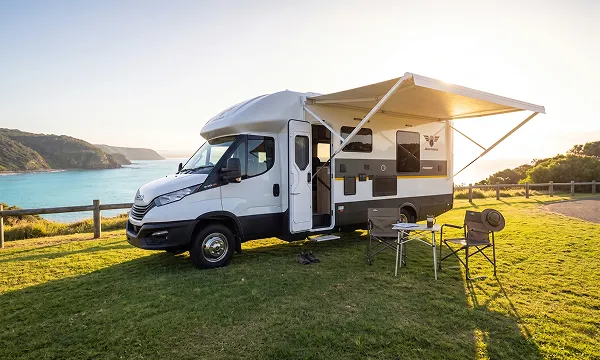
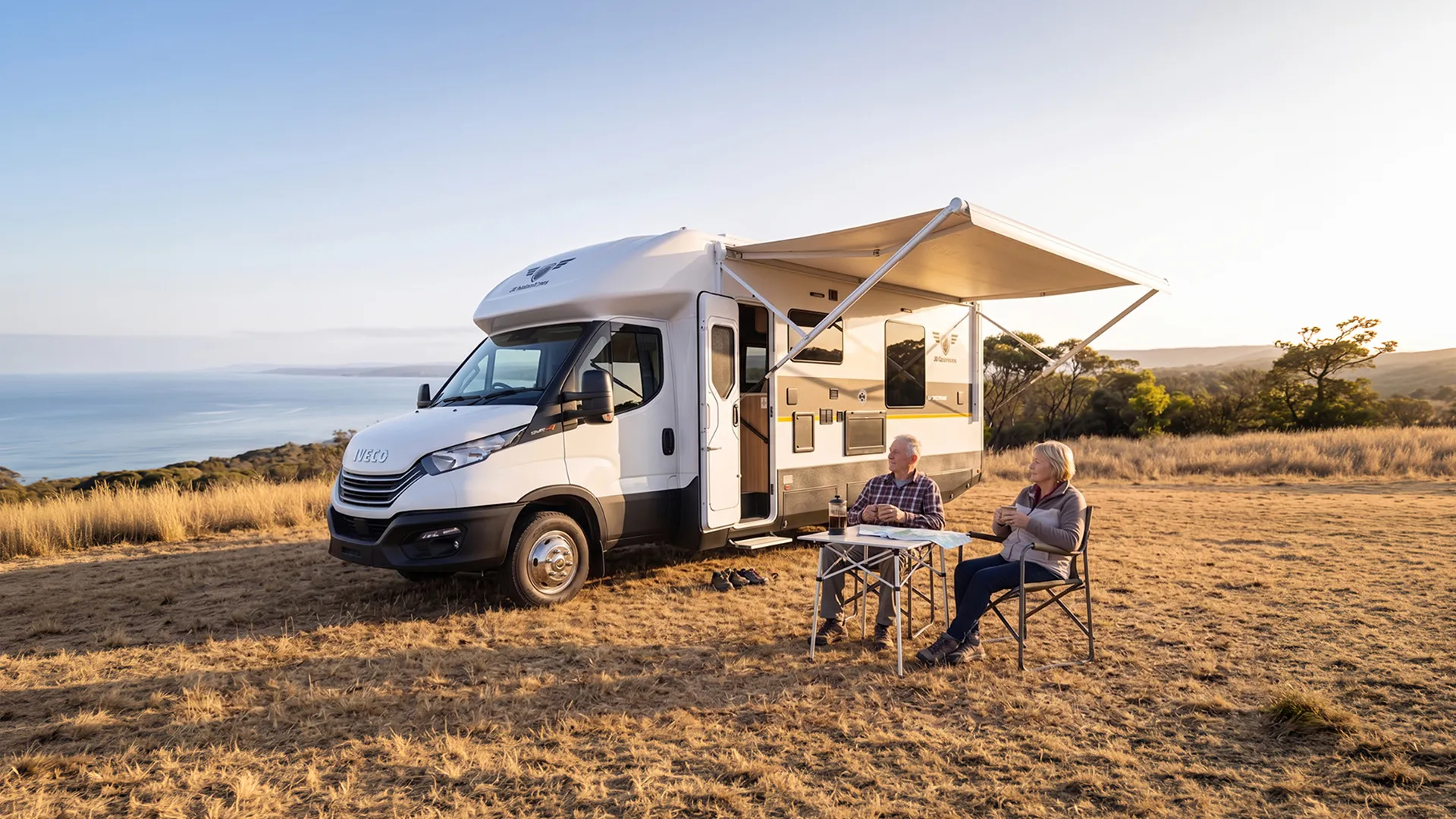

At some point in caravan ownership, towing stops being worth it. The hitching, the GVM calculations, the constant questions about which tow vehicle. The JB Touring is the answer to that question. One motorhome platform, seven layout configurations, driven on a standard Australian car licence.
What is a motorhome, and why choose one over a caravan?
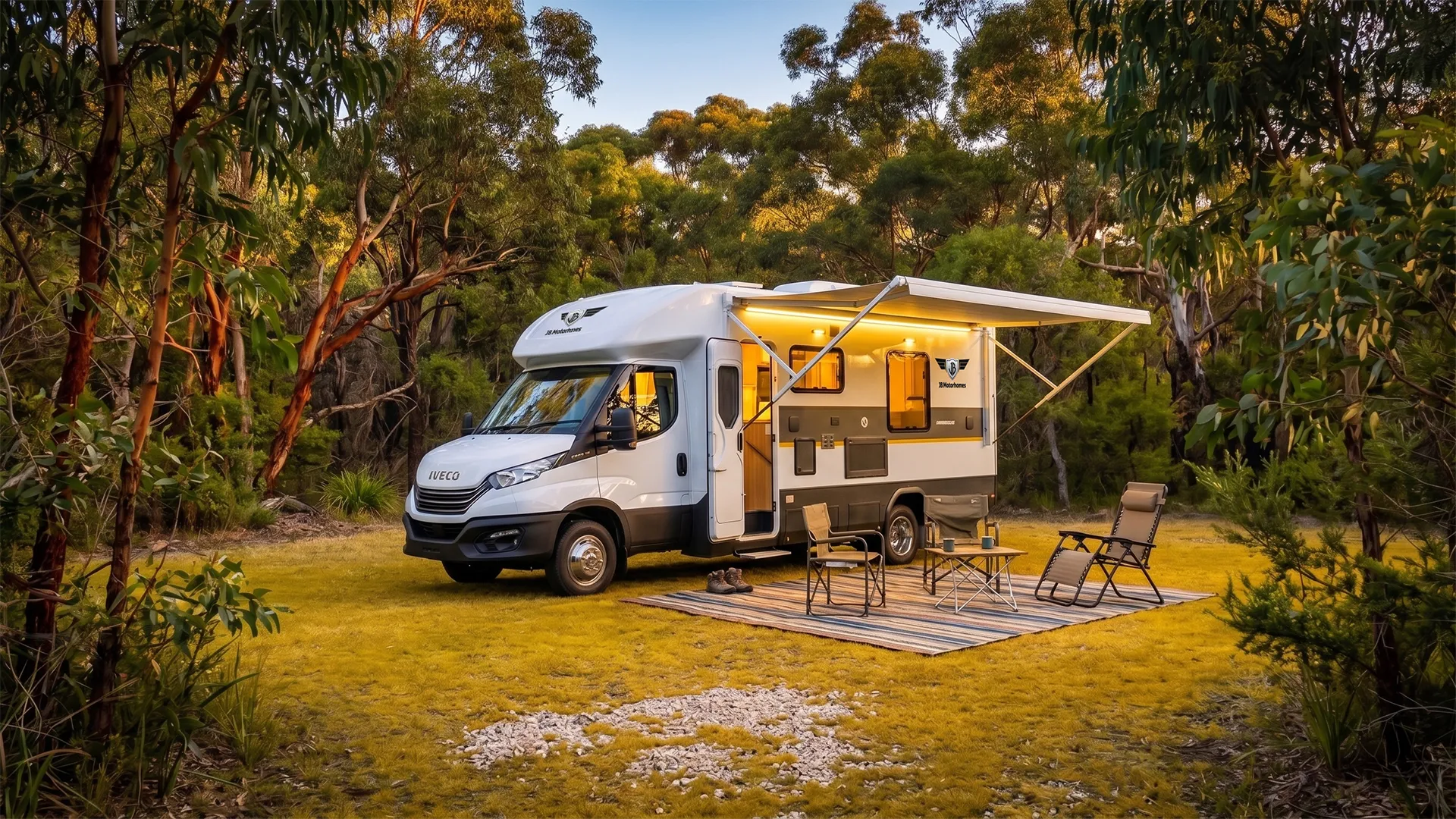
A motorhome is a self-contained vehicle that combines the tow vehicle and the caravan into one. You drive it, you sleep in it, you cook in it, you live in it. The JB Touring is built on an Iveco Daily commercial chassis and driven on a standard Australian car licence under 4,500kg GVM.
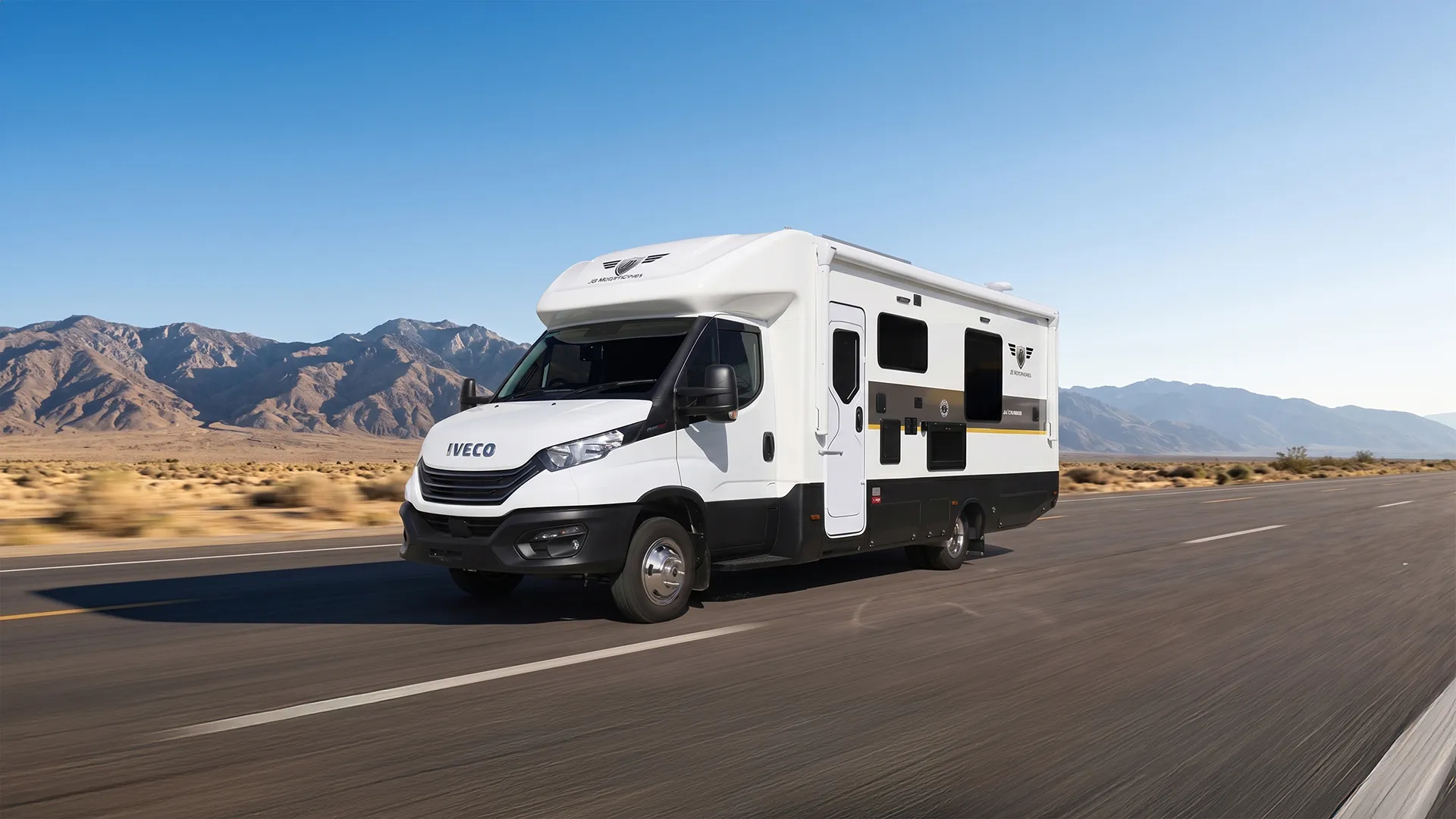
The decision to switch from a caravan to a motorhome is rarely about money. It is about logistics. Hitching, levelling, deploying stabilisers, packing down. The caravan routine adds up to roughly an hour per stop across the day. The motorhome routine takes the same hour out entirely.
Most buyers who switch to a motorhome have already owned a caravan for ten years or more. They know what they want from the trip. What they no longer want is the towing infrastructure underneath it.
There are trade-offs. A motorhome is one vehicle, which means you park it everywhere and detach nothing. A caravan separates from the tow vehicle, giving you a day-trip car. Motorhome owners typically tow a small car behind for that reason, or use bicycles for short trips from camp.
The JB Touring motorhome explained
The JB Touring is JB's only motorhome, built on the Iveco Daily commercial chassis. Seven layout configurations across the range, all 7.9m long, all driven on a standard car licence. 4,495kg GVM, 200L fresh water, EcoFlow 4kW lithium with 600W of solar, induction cooking. From $236,500 driveaway.
One platform, seven ways to configure the interior, designed for couples who want serious touring capability without towing. The full JB Touring model page sits with current pricing for every layout, but the layout-by-layout breakdown is below.
Why the Iveco Daily?
The Iveco Daily is the most established motorhome chassis in Australia. Avida, Sunliner, Winnebago, and Suncamper all build on it. 3.0L Euro 6 turbo diesel, 8-speed automatic, adaptive cruise control, four airbags, and the full electronic safety suite. Designed to drive like a car, supported by a national Iveco service network.
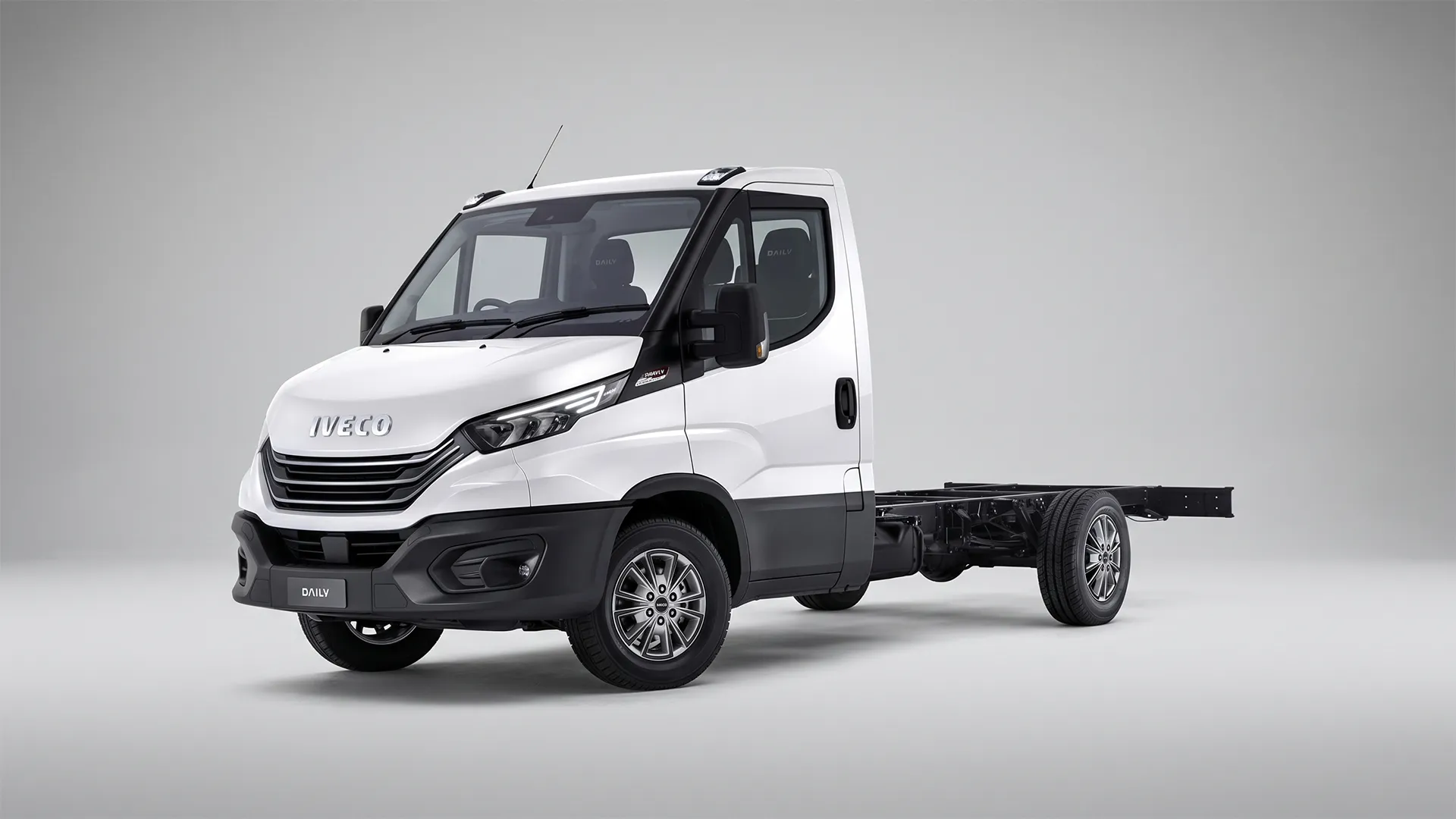
Chassis matters more in a motorhome than it does in a caravan. The chassis is the vehicle. The engine, the transmission, the brakes, the safety systems, the steering, the suspension. JB builds the body and the interior on top, but the underlying drive is Iveco.
The Daily platform runs the 180EVID F1C heavy-duty Euro 6 engine, 132kW at 3,500rpm. The 8-speed ZF Torque Converter automatic (Hi-Matic 8HP70L) shifts smoothly enough that long days at the wheel feel less like driving a truck and more like driving a large SUV.
The safety suite is genuinely strong. Adaptive cruise control, advanced emergency braking, hill holder, hydraulic brake assist, trailer sway mitigation, roll-over mitigation, crosswind assist. Four airbags including curtain airbags with seat-belt pretensioners. The Iveco safety package is one of the reasons the platform dominates Australian motorhome manufacturing.
National service support matters when you are touring. Every capital city has an Iveco dealer. Most regional centres have one within a few hours. Routine servicing happens through the Iveco network. JB handles the body and interior warranty separately.
The seven JB Touring layouts
The JB Touring comes in seven layout configurations. Three queen-bed variants (Straight Lounge, Café Lounge, East-West Bed), two single-bed variants (front and rear positioning), one queen-bed Slideout, and one rear Club Lounge Lift Bed. Pricing ranges from $236,500 to $248,500 depending on configuration.
Layout is the most personal decision in motorhome buying. The same chassis, the same kitchen, the same bathroom, but the sleeping and living arrangement changes how the vehicle works on a long trip.
Queen Bed Straight Lounge (from $236,500)
The entry point and most popular configuration. Queen bed at the rear, full-width side lounge, kerbside kitchen, ensuite behind the cab. The classic motorhome layout, suited to couples who live mostly outside the vehicle and want a clean, open interior when inside.
Queen Bed Café Lounge (from $236,500)
Same price as the Straight Lounge but with a café dinette instead of the side lounge. Better for couples who eat at a table rather than on the lounge, or who plan to do work or trip planning at a proper desk surface during longer trips.
Queen Bed East-West (from $239,000)
Queen bed positioned across the width of the motorhome with access on both sides. Either partner can get up at night without climbing over the other. The layout most older couples wish they had chosen first time around. A small $2,500 premium for a daily comfort upgrade.
2 x Single Beds (from $239,500)
Two single beds in place of the queen, positioned behind the cab. Optional push-together hardware lets the beds combine into a king when needed. Suits couples who sleep differently, or buyers who travel occasionally with an extra adult.
2 x Single Beds Rear (from $239,500)
Same single-bed configuration but at the rear of the motorhome rather than behind the cab. Frees up the centre of the vehicle for a larger lounge and dining space. The layout for couples who use the living space during the day more than the bed.
Queen Bed Slideout (from $248,500)
The premium configuration. A full-width slideout section extends the living space by roughly a metre when the motorhome is parked. Queen bed, expanded side lounge, dramatically more internal space at camp. Worth the $12,000 premium for buyers who spend long days inside the vehicle.
Rear Club Lounge Lift Bed (from $248,500)
A lift bed at the rear over a generous club lounge. The bed raises to the ceiling during the day, exposing a full U-shape lounge underneath. The layout for buyers who want maximum living space during the day and a full queen bed at night, without compromise on either.
What is standard in every JB Touring?
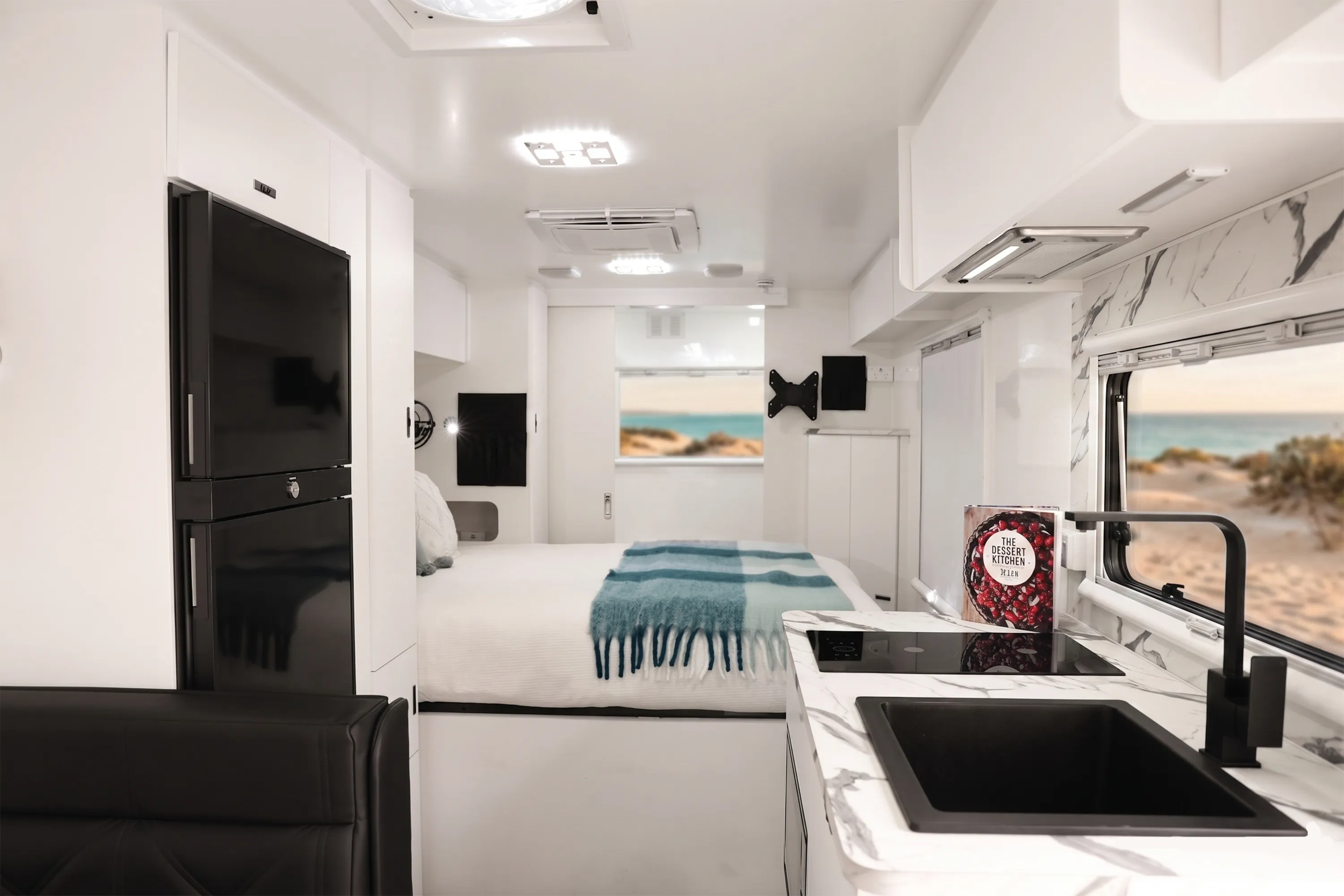
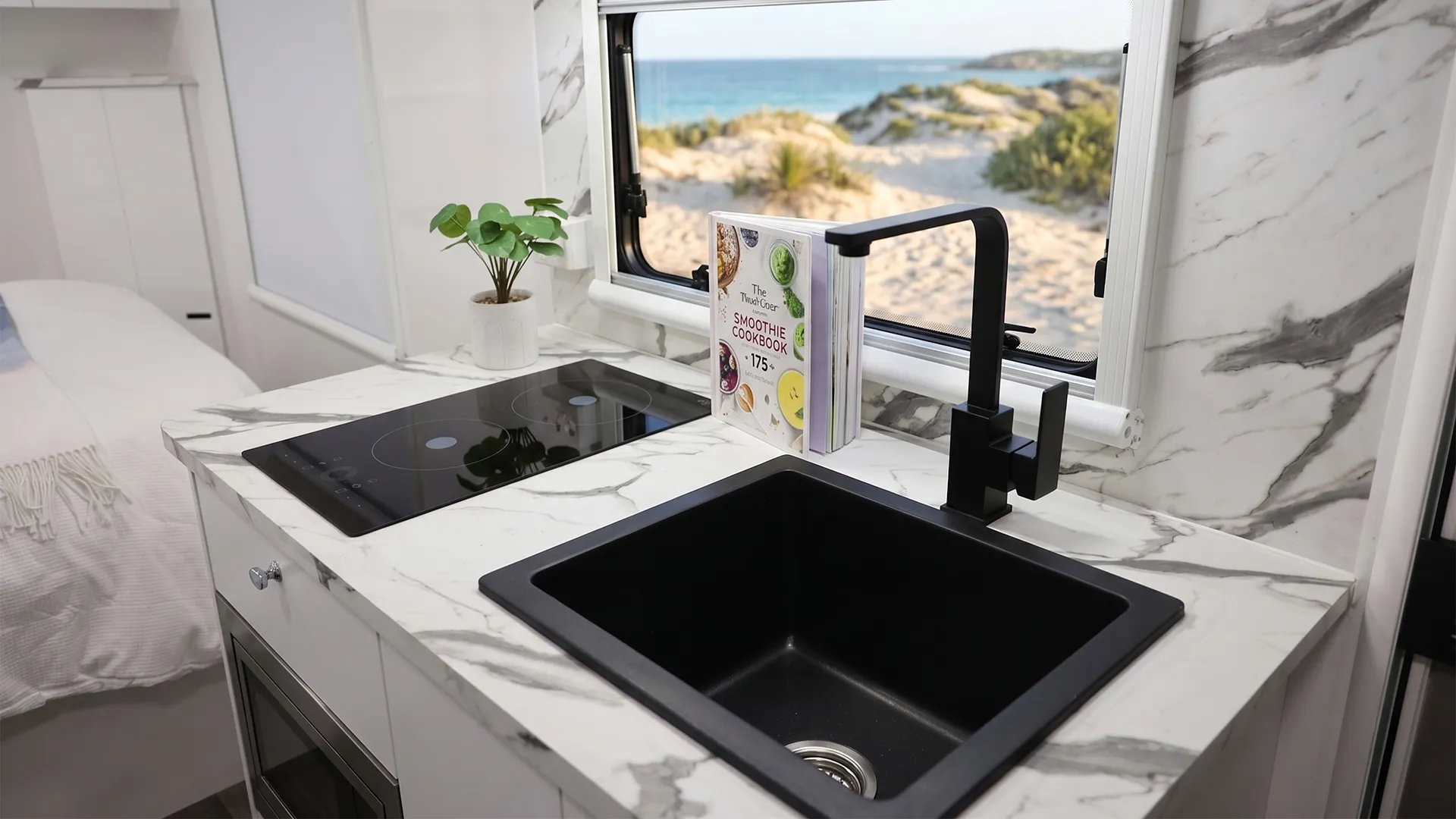
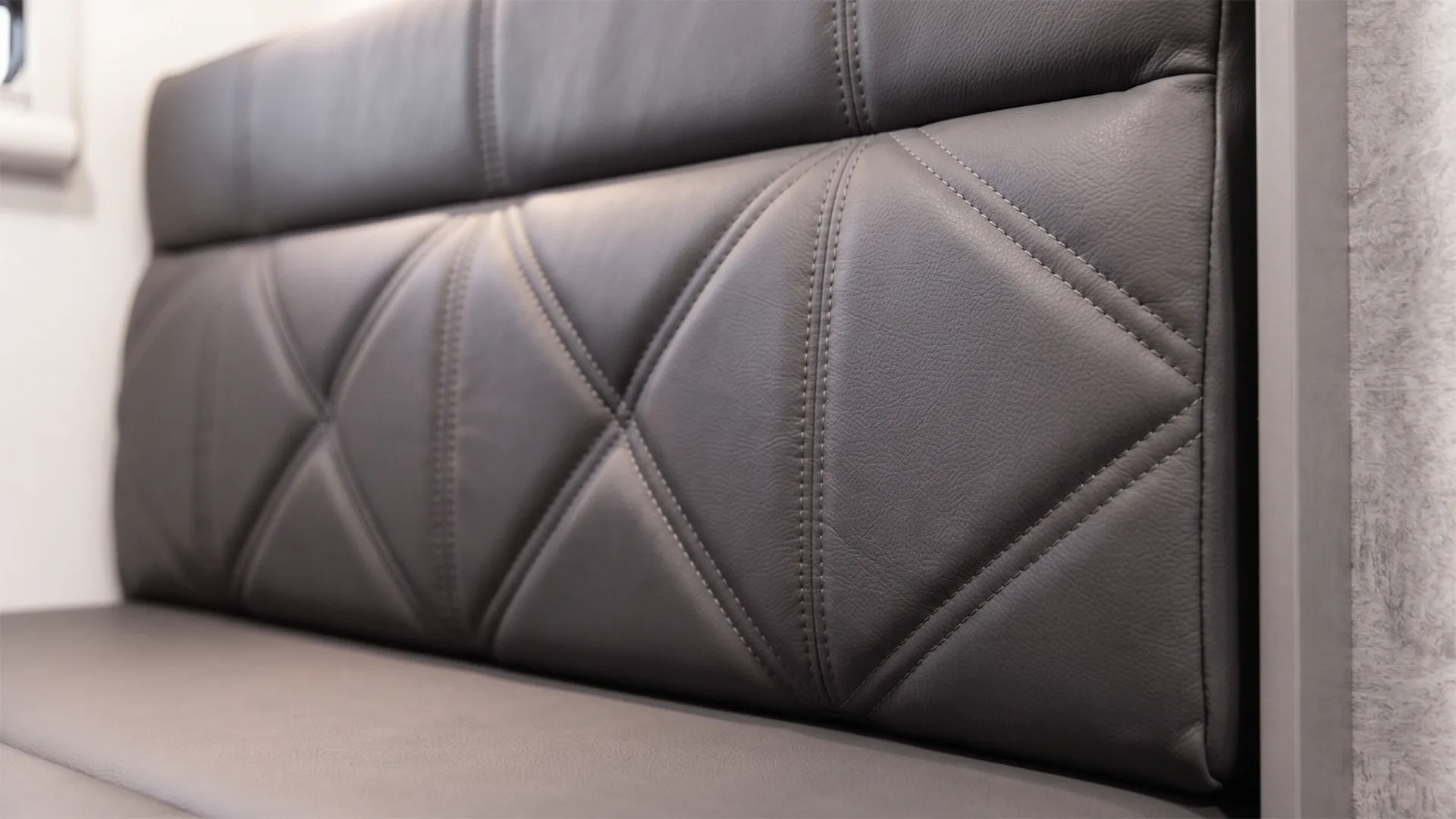
Every JB Touring layout ships with the same core fit-out. Premium leather seating, a 224L upright compressor fridge, induction cooktop, reverse-cycle air conditioning, 200L fresh water, EcoFlow 4kW lithium with 600W of solar, electric awning, two 24-inch smart TVs, and a Fusion Marine sound system with internal and external speakers.
The standard specification on a JB Touring is the answer to most "is it worth the premium" questions. The base layout at $236,500 is not stripped back. It is the full motorhome, with the layout being the only meaningful variable.
The chassis is the Iveco Daily MY22 with C-section steel longitudinal members and tubular cross members. The body is composite sandwich panel with extruded polystyrene core, impact resistant, thermally insulated. The roof is one-piece fibreglass with thermal reflective coating. These materials hold the vehicle together across long touring distances and high temperature variations.
The interior runs genuine 100% leather seating, Gerflor premium vinyl flooring with sound-isolating felt back, three Sirocco fans, a 900mm by 750mm shower, a 25L microwave, and a 3kg top-load washing machine. The kitchen has a waterfall benchtop and a 3-way tap with inline carbon filtration.
Safety is standard, not optional. Four SRS airbags including curtain airbags with seat-belt pretensioners. Adaptive cruise control. Advanced emergency braking. Hill holder, hydraulic brake assist, trailer sway mitigation, roll-over mitigation, crosswind assist. Daytime running lights, fog lights, Safety Dave wireless rear camera. All standard.
Power and off-grid capability
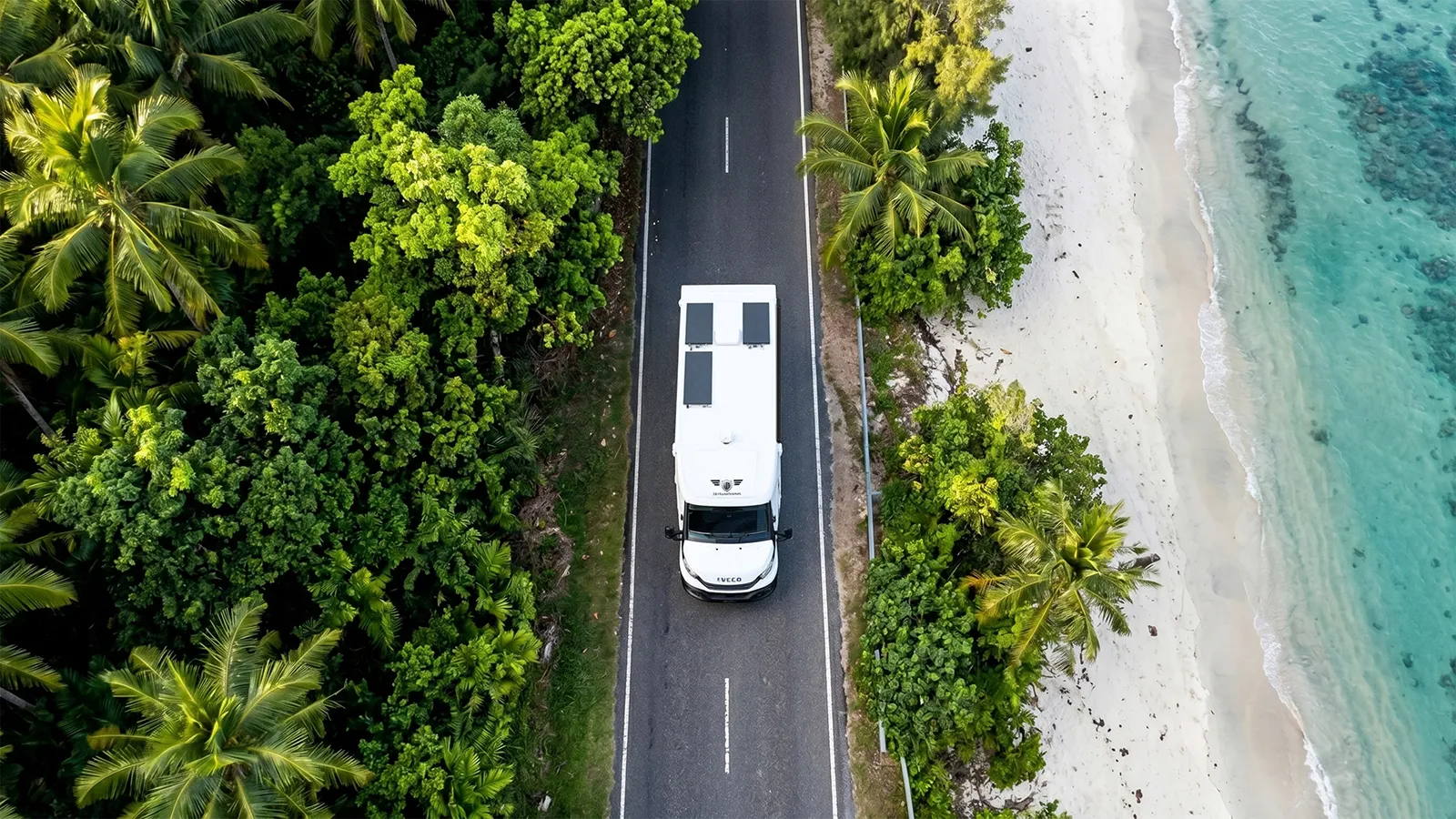
The JB Touring runs an EcoFlow 4kW lithium system (333Ah) with 600W of solar and a 3,600W inverter. Induction cooking runs from this system. The 224L compressor fridge runs from this system. Three to four nights off-grid as the realistic ceiling, with shore power as the norm at longer stops.
Power capacity in a motorhome is balanced against weight and space differently than in a caravan. The 4kW EcoFlow system is the right size for the Touring's trip pattern, which leans heavily toward overnight stops at caravan parks, scenic pull-offs, and the occasional free camp.
Induction cooking is standard. There is no gas cooktop and no gas hot water service. Two gas bottles support the cabin heater only. This is closer to the JB EV caravan setup than to the standard gas-equipped vans.
For the full power sizing logic and how this system compares to the caravan ranges, our caravan battery and power guide covers the maths.
What licence do you need to drive a motorhome in Australia?
A standard Australian car licence (Class C) is enough to drive the JB Touring in its standard 4,495kg GVM configuration. The optional 5,200kg GVM upgrade requires a Light Rigid (LR) licence in most states. No truck licence, no special endorsement, no additional test for the standard build.
The licence question is often the first one motorhome buyers ask. The 4,500kg GVM ceiling is set by Australian transport authorities as the boundary between car and light rigid licences. The Iveco Daily platform that the JB Touring is built on can be configured either side of that line.
Most buyers stay with the 4,495kg standard configuration, which keeps the vehicle inside Class C licence territory. The 5,200kg upgrade adds carrying capacity for buyers who plan to tow a small car or carry significant additional gear. It also adds the licence step, which is a real consideration for older buyers.
Worth checking your specific state. Licence rules vary slightly across Australia, particularly around tow-vehicle combinations and trailer towing from a motorhome.
What does daily life in a motorhome actually feel like?
The biggest day-to-day difference between a motorhome and a caravan is setup time. A caravan setup takes 15 to 30 minutes at every stop. A motorhome setup takes 30 seconds. Park, switch the engine off, make coffee. The hour you saved gets spent at the destination instead.
The first week of motorhome ownership is the recalibration. New owners keep waiting for the setup step that does not exist. There is no hitching to undo, no awning to deploy (unless you want to), no stabilisers to lower. You park, you live in it.
The trip pattern shifts as a result. Motorhome owners typically take more, shorter stops. The friction of moving is so low that pulling off for a two-hour break feels worthwhile. Caravan owners tend to plan longer drives between fewer stops, because the setup-and-pack-down cycle has to justify itself.
The trade-off is detachability. A caravan owner unhooks the van at camp and uses the tow vehicle for day trips. A motorhome owner either drives the motorhome everywhere or carries bicycles. Many JB Touring buyers add a tow ball and pull a small car behind, but that adds back some of the complexity that drove the original switch.
Australian made and dealer supported
The JB Touring is built at the JB Caravans factory in Campbellfield, Victoria. The body, interior, and fit-out are Australian made. The chassis is Iveco Daily, supported by Iveco Australia's national dealer network. Every JB Touring ships with a 5-year structural warranty on the build and the standard Iveco warranty on the chassis.
This is the practical advantage of buying a motorhome built locally on an Iveco platform. The body and interior are supported by JB. The chassis, engine, and transmission are supported by Iveco. Both networks have national coverage, which matters when you are touring in a country this size.
For the strategic case for Australian-made caravans and motorhomes (resale value, parts availability, ADR compliance), our piece on why Australian-made caravans matter covers the full story.
Ready to see the JB Touring up close?
The full JB Touring lineup with every layout and current pricing sits on one page. Your local JB dealer can walk through all seven configurations with you and answer the licence question on the spot.
Browse the JB Touring range Find your nearest dealer