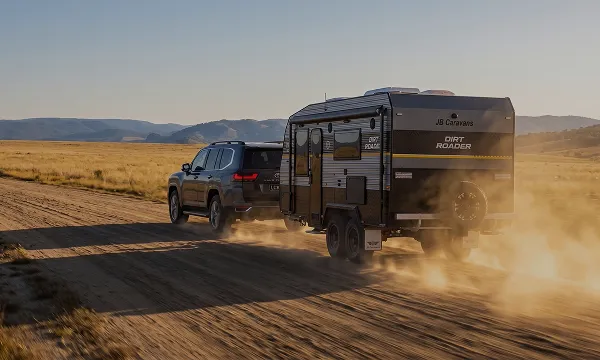

Full off-road caravans are built for the country most caravans cannot reach. This guide covers what defines the category, the four model families in the JB range, and how to pick the one that matches your tow vehicle, your trip plan, and your trip duration.
What is a full off-road caravan?
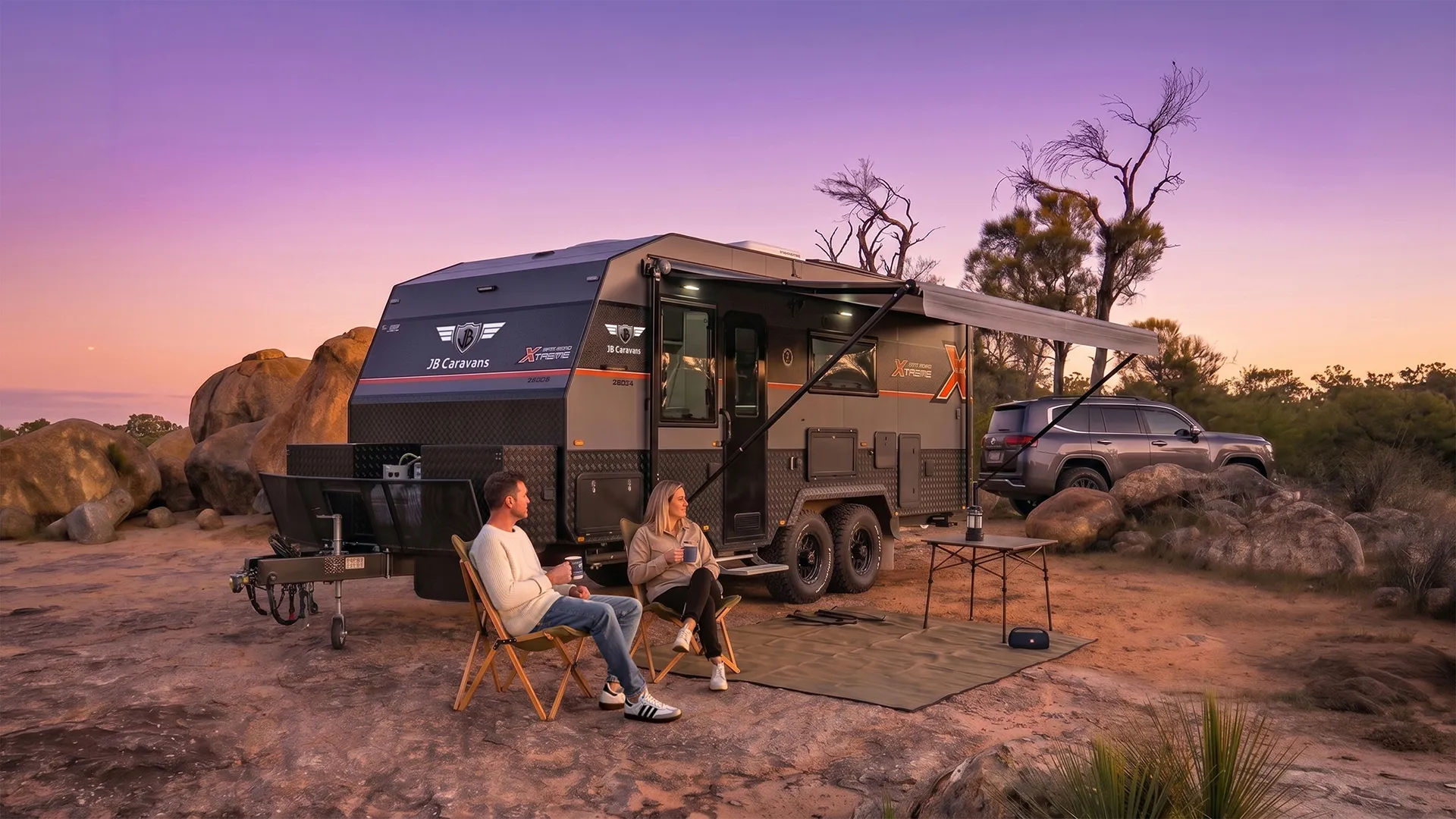
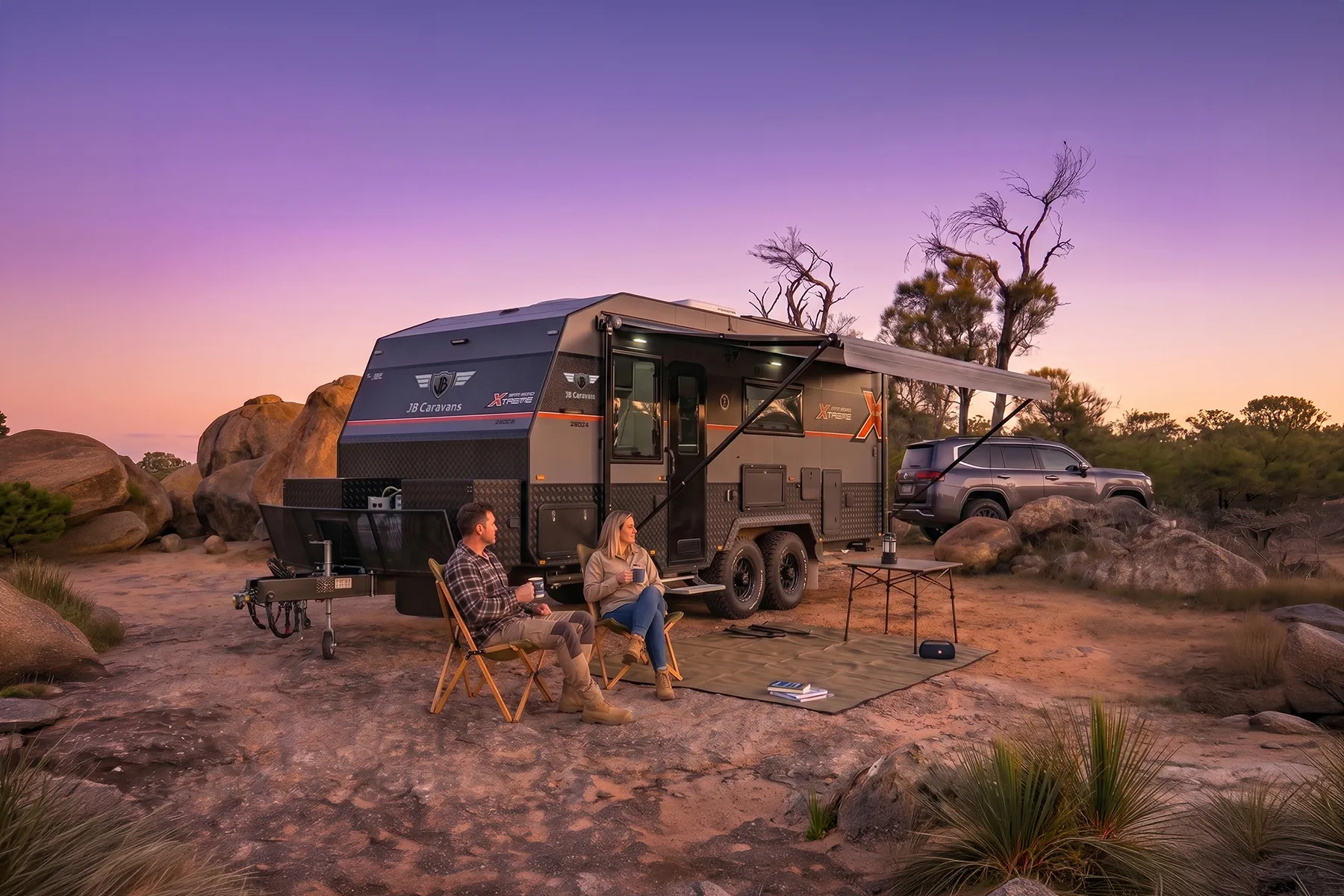
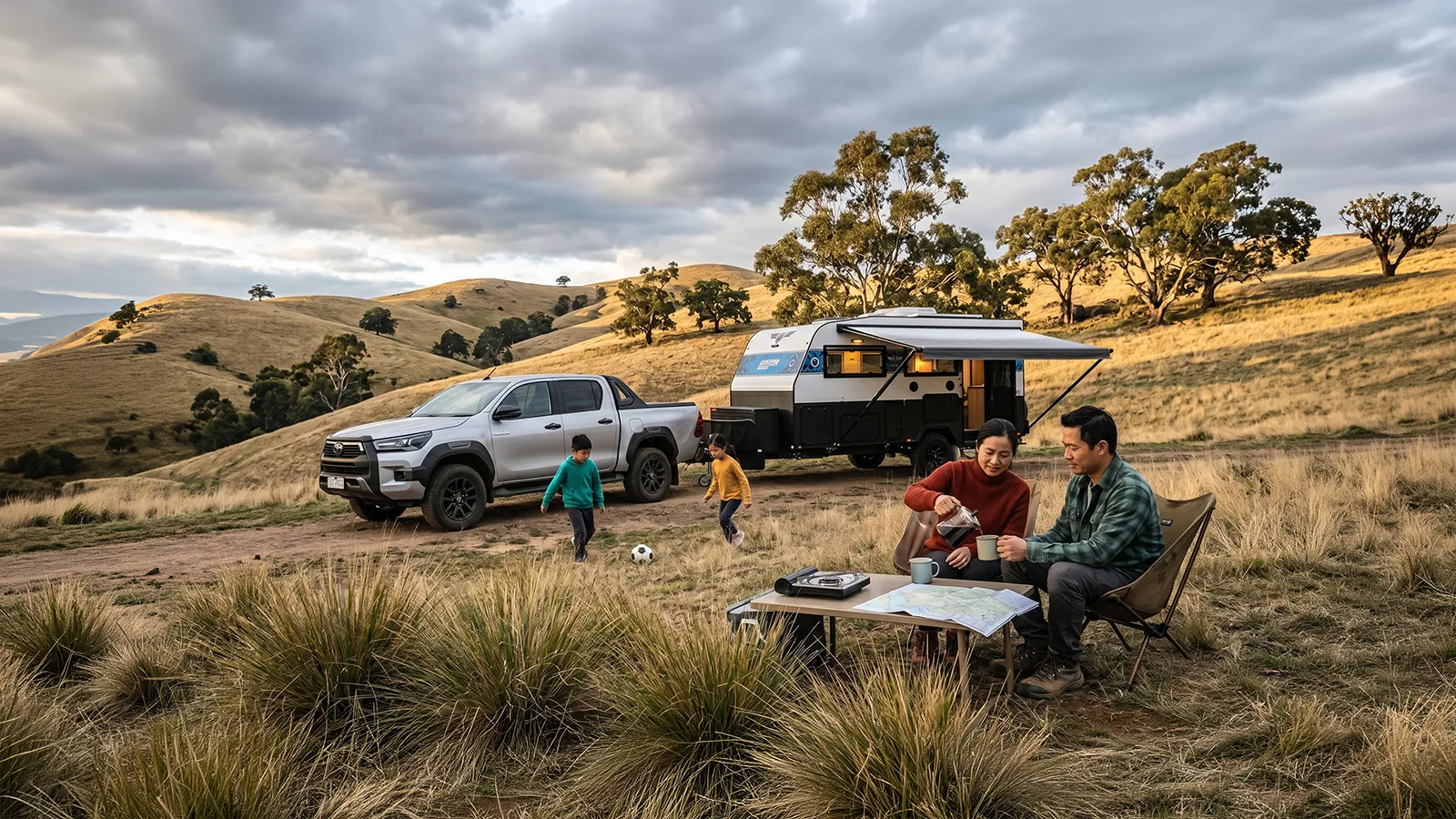
A full off-road caravan is built for genuinely remote travel where dealer support is days away. It has serious ground clearance, heavy-duty active or upgraded passive suspension, off-grid power for five-plus nights, and water capacity to match. Built for Cape York, the Canning Stock Route, the upper Kimberley, and the Simpson Desert.
Full off-road sits at the top of the caravan capability stack. Above on-road. Above semi off-road. Built for the country where everything else stops working.
Three things separate a full off-road caravan from a semi off-road one. The first is suspension, either active-levelling or significantly higher-rated than semi off-road equivalents. The second is off-grid capability, with lithium battery systems built for five to seven nights without shore power. The third is structural toughness, including the chassis, the cladding, the seals, and the recovery points.
The full off-road caravans in the JB range
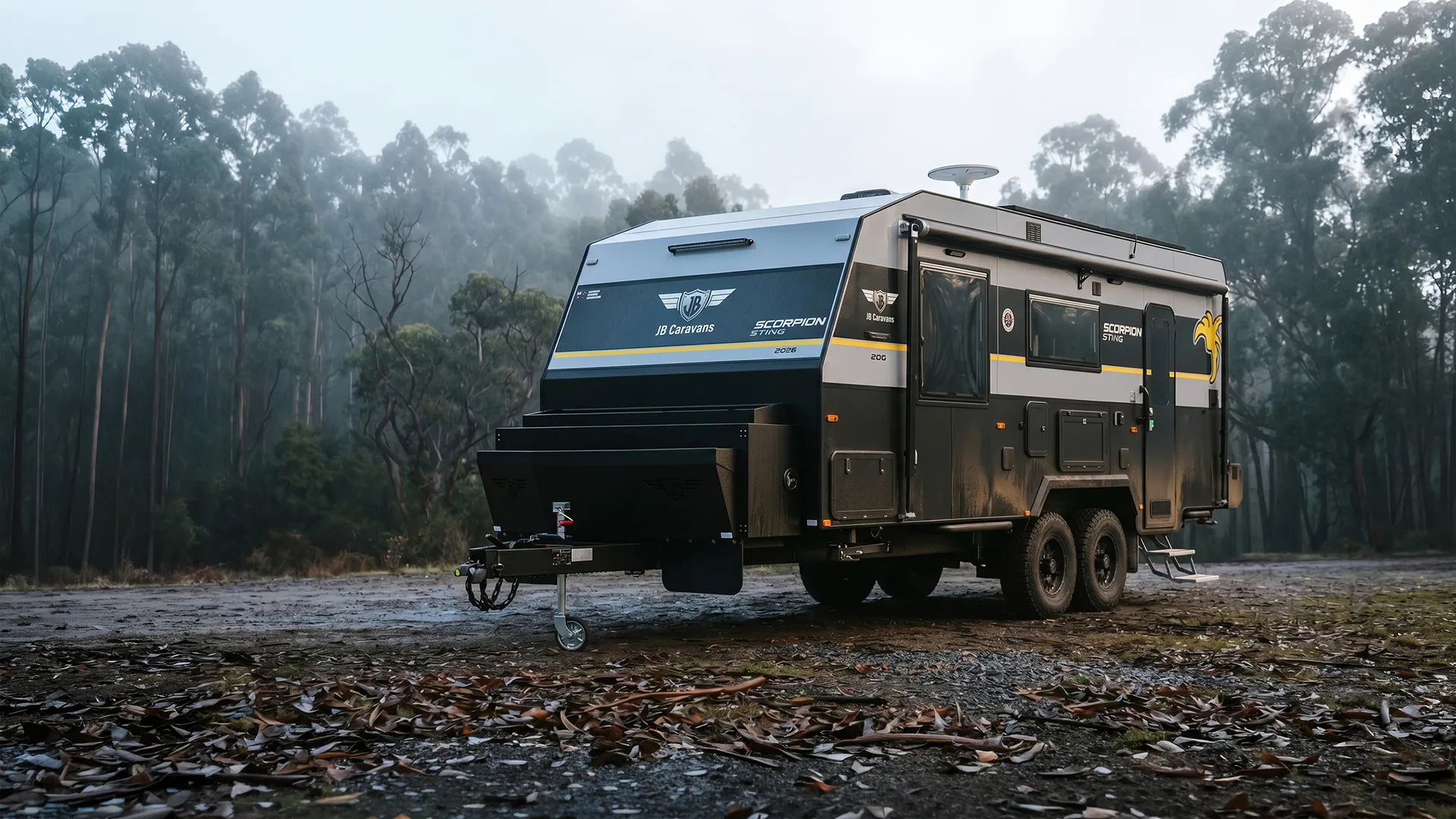
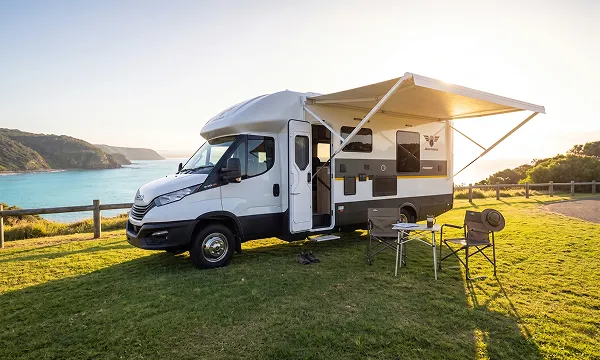
JB Caravans builds four full off-road model families. The Gator Hybrid is the compact entry point. The Gator X is the only mid-size-towable van with active-levelling suspension. The Scorpion Sting is the premium passive-suspension option. The Scorpion Sting Air is the flagship for genuinely long trips.
Each model family answers a different question about how you tow, where you go, and how long you stay. The full full off-road range sits on one category page with current pricing for every variant.
Gator Hybrid 14 and 16: the compact full off-roader
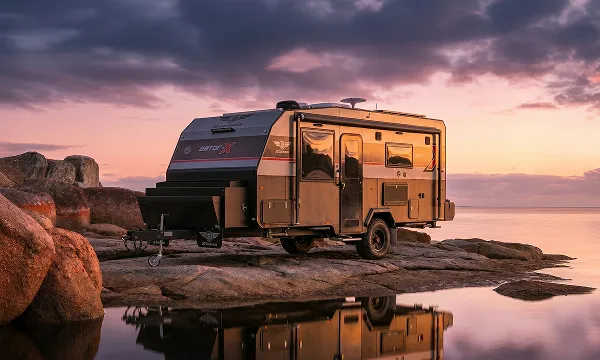
The Gator Hybrid is the smallest, lightest full off-road caravan in the JB range. Built on a Cruisemaster XT 2.8T single axle with EcoFlow lithium and Raptor-coated sides, it is full off-road rated but light enough for a mid-size 4WD. Available in 14ft from $118,100 and 16ft from $123,100.
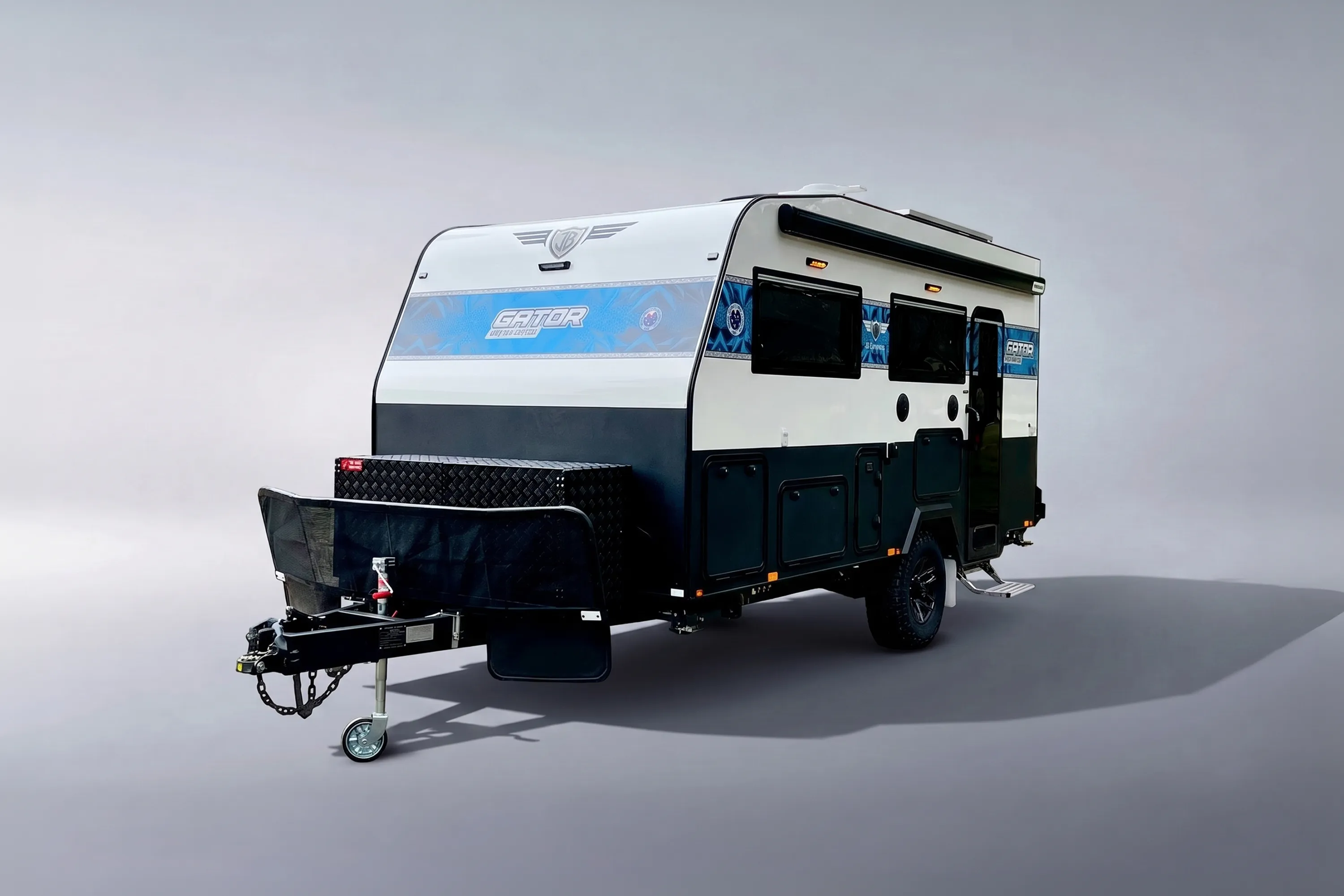
The Hybrid solves a specific buyer problem. Most full off-road vans sit at 3,000kg or more, which puts them past the comfortable towing capacity of a HiLux, Ranger, or D-MAX. The Hybrid sits at 2,800kg ATM, well inside that range.
It runs a 2kWh EcoFlow lithium battery with up to 600W of solar. Slideout kitchen. Single sleeping zone. Two people, two weeks, full off-road country. That is the brief. Couples who want capability without the chassis weight or tow-vehicle requirements of the larger Scorpion models.
The 14ft suits compact storage and tight access tracks. The 16ft adds two extra feet of internal space without changing the towing footprint. The full Gator family breakdown sits in our guide to compact off-road caravans.
Gator X and Gator X EV: full capability for a mid-size 4WD
The Gator X is the genuinely interesting model in the JB full off-road range. It runs the same ATX Airbag BCS active-levelling suspension as the flagship Sting Air, in a 16 to 18.5ft body that a HiLux can tow without strain. From $129,600 driveaway, with an EV-ready variant at the same price.
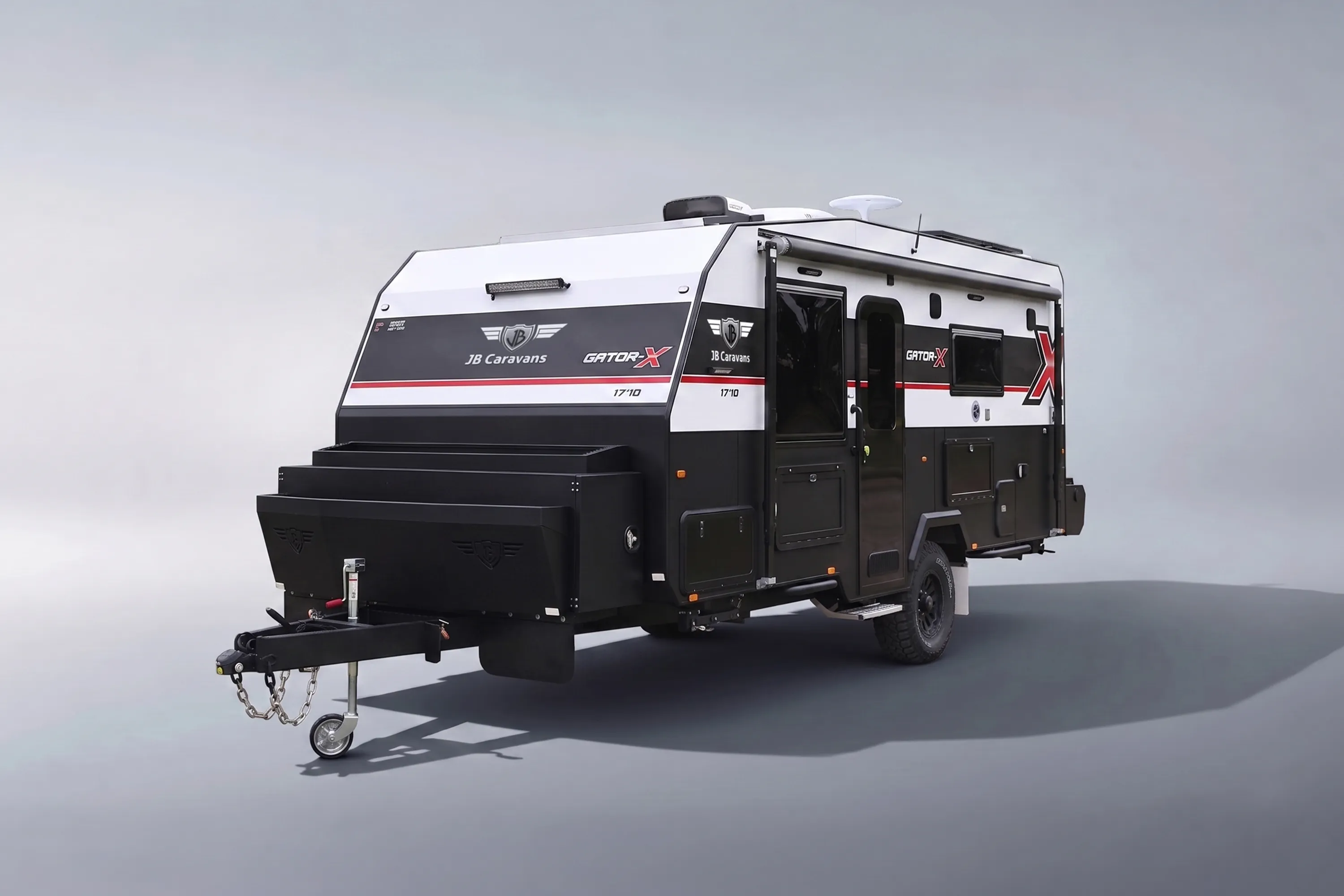
This is the model that breaks the rule. Active-levelling suspension is usually the preserve of 4,500kg vans towed by 200 Series and 300 Series LandCruisers. The Gator X puts the same suspension in a 3,000kg to 3,500kg body, which means mid-size 4WDs can tow it without GVM gymnastics.
Twelve layouts in each variant. Single axle from 16ft to 17ft 10, tandem axle from 18ft to 18ft 6. Café, L-lounge, club, single beds, and family bunks in B2 and B3 configurations.
The Gator X EV runs at the same sticker as the standard Gator X, but ships with induction cooking, an electric slideout BBQ, a BlackJack electric jockey wheel, and the 10kW EcoFlow lithium system from the Sting Air range. No gas, no compliance, no refills. The closest thing to a Sting Air at Gator X pricing.
The full Gator range comparison and a layout-by-layout breakdown sits in our guide to compact off-road caravans. Or browse the Gator X model page for current pricing and layouts.
Scorpion Sting: full off-road without the active levelling
The Scorpion Sting is the entry point into the premium Scorpion range. ATX Coil 4.5T suspension (passive, not active), EcoFlow 5kW lithium with 800W of solar, 20 layouts, ATMs from 3,500kg to 4,500kg. From $143,000 driveaway, roughly $30,000 below the Sting Air.
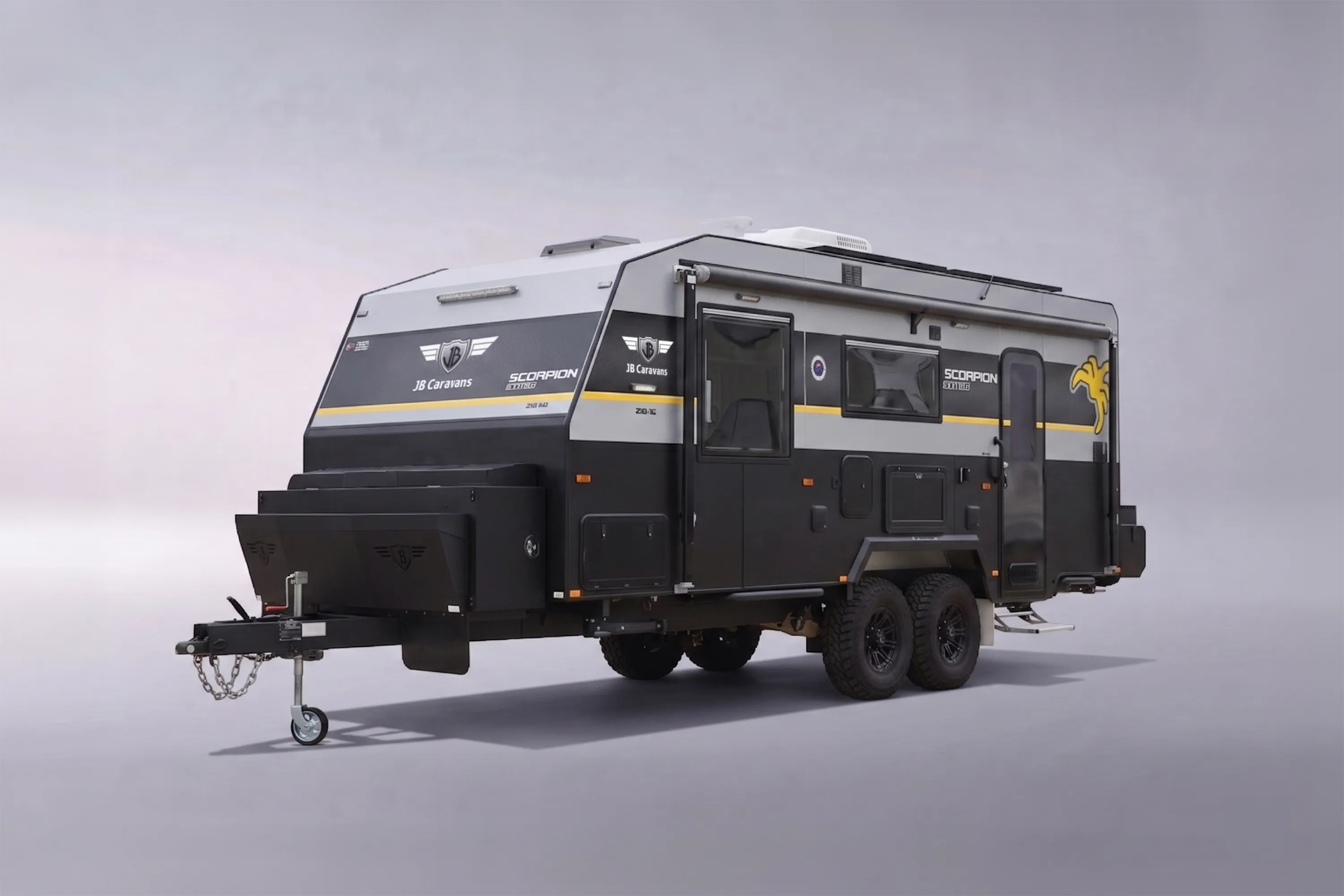
The Sting is the honest answer for buyers who want the Scorpion footprint and the Scorpion build quality, without the active-levelling suspension or the 10kW power system. Passive coil suspension means no airbags, no compressor, no electronic levelling. Fewer components, fewer failure points, easier to service.
Twenty layouts covers café, club lounge, family bunks (B2 and B3), large ensuites, corner showers, and East-West Bed. The full Scorpion family layout language is available here, just without the Air's active suspension and slideout kitchen.
For the full Scorpion range breakdown with side-by-side comparisons, our guide to luxury off-road caravans covers the choice. Or browse the Scorpion Sting model page for current pricing and layouts.
Scorpion Sting Air and Air EV: the flagship for the long lap
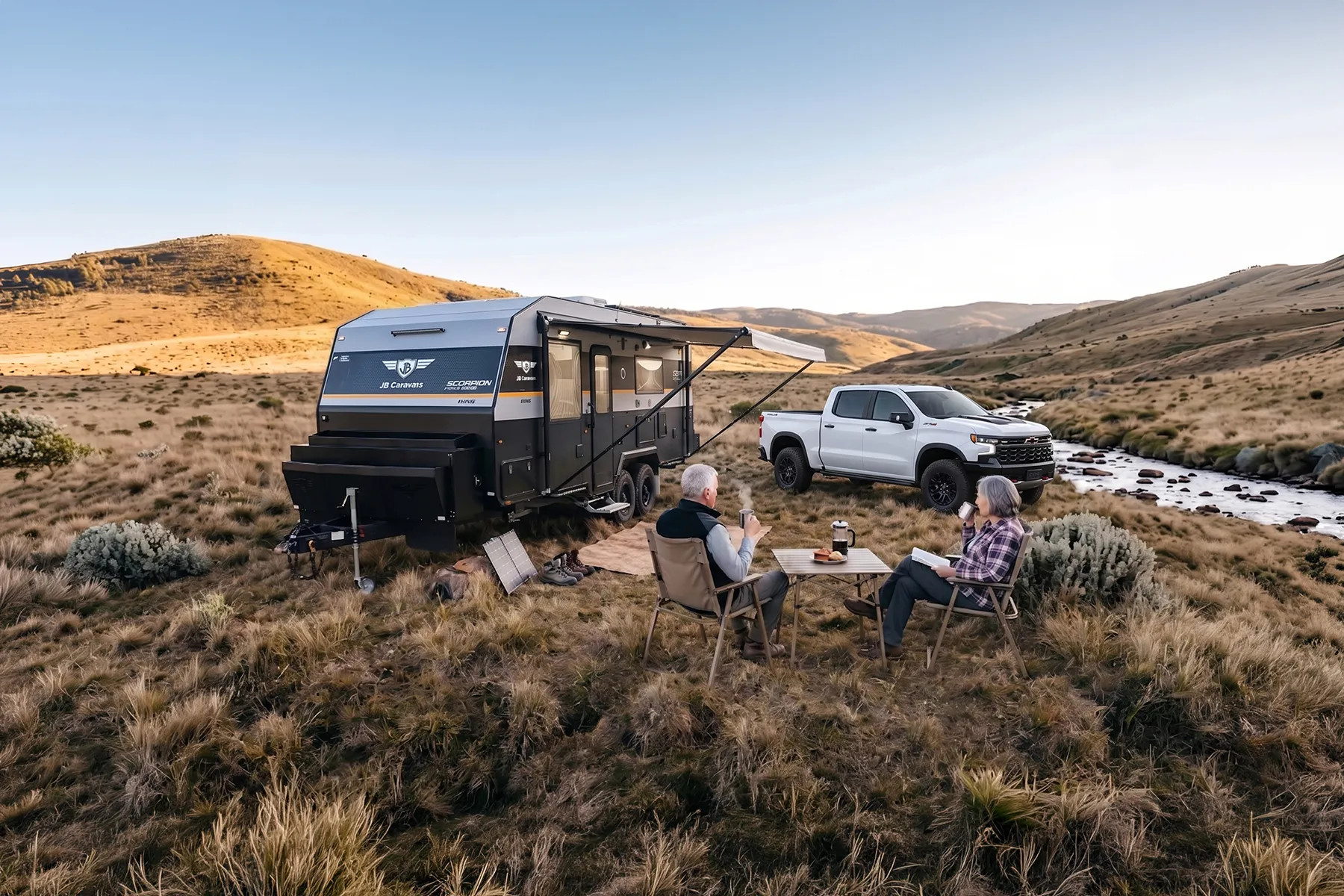
The Scorpion Sting Air is JB's flagship. ATX Airbag BCS active-levelling suspension, EcoFlow 10kW lithium with 1,000W of solar, electric awning, slideout kitchen, composting toilet, and 22 layouts. From $173,000 driveaway, with an EV-ready variant at the same price.
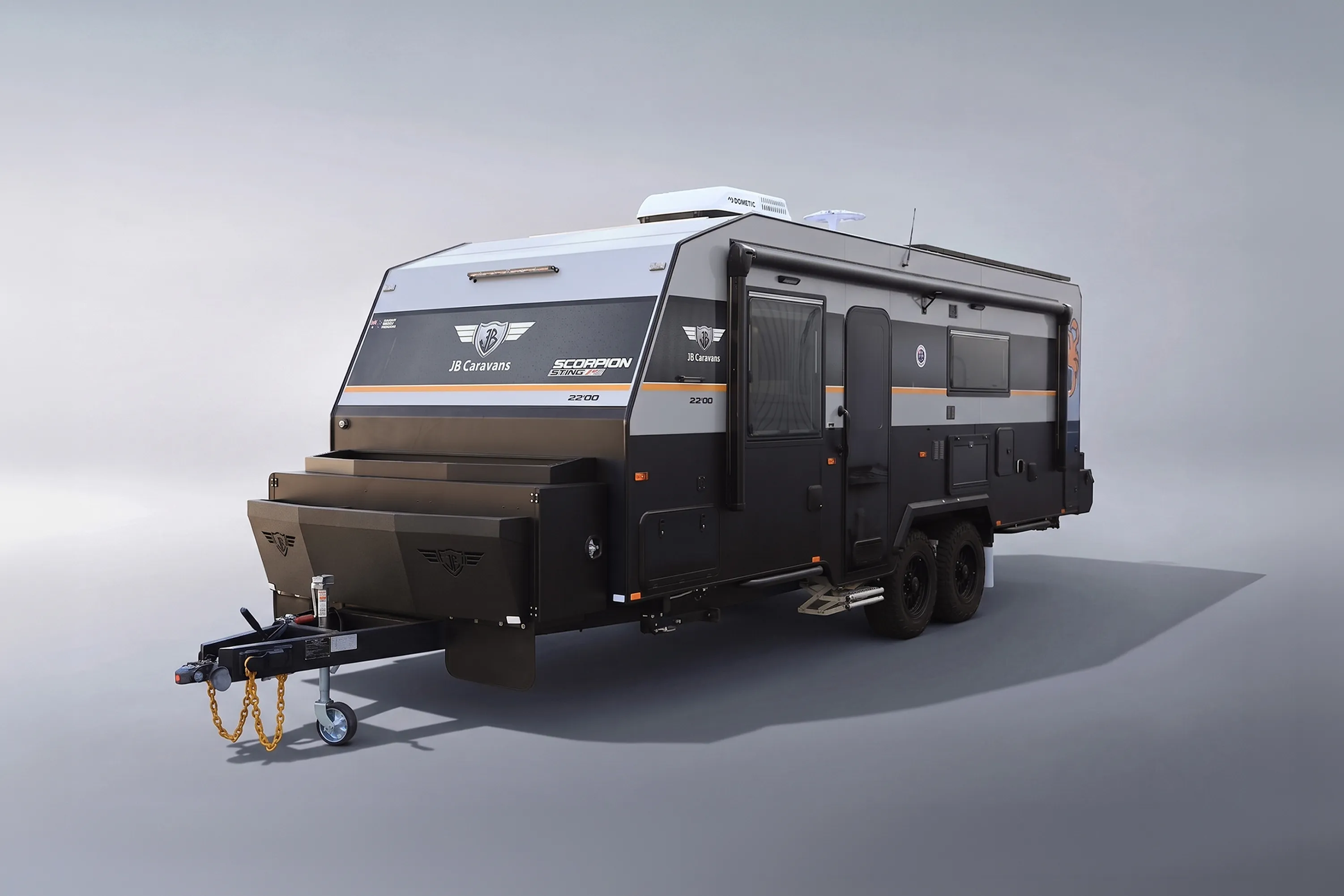
This is the van built for the long lap. Three weeks is easy. Three months is comfortable. The active-levelling suspension reads the road and adjusts the airbags in real time, which is the difference between arriving at camp comfortable and arriving wrecked.
The 10kW EcoFlow lithium system with 1,000W of solar handles five to seven nights off-grid as the norm. The composting toilet removes black water dump-point planning. The slideout kitchen sets up in seconds rather than minutes. These details are not gimmicks. They are the difference between a long-trip van and a long-weekend van.
The Sting Air EV sits at the same sticker as the Sting Air, swapping gas for induction cooking, electric hot water, an electric slideout BBQ, and a BlackJack electric jockey wheel. Built for buyers running an EV or hybrid tow vehicle, or anyone who wants to remove gas from the towing equation entirely.
The full Scorpion range breakdown sits in our guide to luxury off-road caravans. Or browse the Scorpion Sting Air model page for current pricing and layouts.
How to choose your full off-road caravan
Match your tow vehicle to the model. Mid-size 4WDs (HiLux, Ranger, D-MAX) tow the Gator Hybrid or Gator X comfortably. Heavy-duty 4WDs (200 Series, 300 Series, Patrol, Ram) suit the Scorpion Sting and Sting Air. Match your trip plan to the power system. Match your budget to the layout you actually want.
Three filters get most buyers to the right model.
The first is tow vehicle. The Gator Hybrid and Gator X are built for mid-size 4WDs. The Scorpion Sting and Sting Air ask more of the tow vehicle and reward heavy-duty platforms. Buying a van your 4WD struggles with is the most expensive mistake in the category.
The second is trip duration and remoteness. Two-week trips with caravan parks in between suit the Gator range and its 2kWh or 5kW battery. Three-month laps and genuinely remote stretches favour the Sting Air's 10kW system and active levelling.
The third is layout. The Hybrid offers one layout per length. The Gator X has 12 per variant. The Scorpion Sting has 20. The Sting Air has 22. The deeper into the range you go, the more layout options open up.
For the four-question filter and worked examples of which buyer suits which model, our semi vs full off-road caravan guide covers the boundary in detail.
Where can a full off-road caravan go?
A full off-road caravan handles Australia's most remote routes. Cape York Peninsula, the Canning Stock Route, the upper Kimberley, and the Simpson Desert. These trips need ground clearance, active or upgraded suspension, water capacity for five-plus days, and a power system that does not depend on shore power.
Specific routes worth knowing about.
Cape York Peninsula
Cape York is the classic test of a full off-road caravan. The Old Telegraph Track is brutal. The bypass route is graded but still demanding. Either way, you need active or upgraded suspension, full off-road clearance, and the self-sufficiency to manage five to seven days without dealer support.
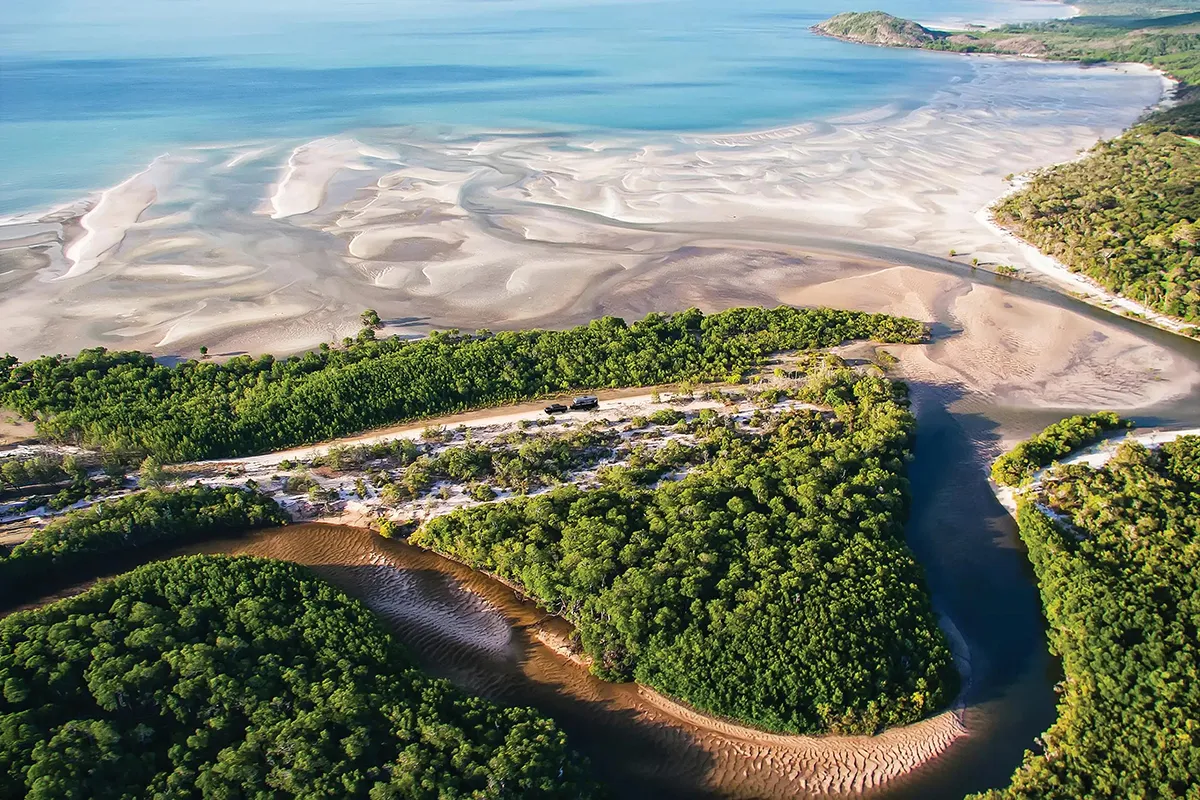
The Sting Air and Gator X handle Cape York comfortably. The Scorpion Sting and the Hybrid handle the bypass route well. Nobody should take a semi off-road caravan up the OTT.
The water and power demands favour the 10kW EcoFlow system. The 5kW system on the Sting and Gator X manages with careful use. The Hybrid's 2kWh system is the limit, suiting shorter Cape sections rather than the full crossing.
The Canning Stock Route
The Canning is the longest off-road touring route in Australia, 1,850km from Halls Creek to Wiluna. It demands a fully self-sufficient caravan with serious water capacity, active suspension, and the resilience to handle sustained corrugations for two weeks straight. The Sting Air is the natural fit.
This is not a trip for the Hybrid or the standard Sting. The fuel and water demands favour tandem-axle vans with the full 10kW power system. The corrugations favour active-levelling suspension. The remoteness favours the 5-year structural warranty and the dealer network behind it.
Most buyers who tackle the Canning do so in the Sting Air or the Gator X EV. Both have the power, the suspension, and the cargo capacity. Both also have owners who have completed the full crossing and returned without major issues.
The Kimberley
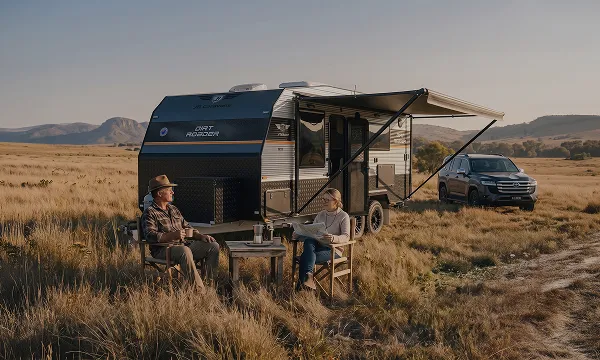
The Kimberley splits into two trips. The main Gibb River Road is reachable in a semi off-road Dirt Roader Xtreme. The deeper Kimberley, Mitchell Falls, Kalumburu, the inland tracks, needs full off-road. The Scorpion Sting, Sting Air, and Gator X EV all handle the deeper Kimberley with appropriate preparation.
What makes the deeper Kimberley different from the main Gibb is the recovery distance. Bell Gorge access has cell coverage. Mitchell Falls has none. A breakdown on the Mitchell Plateau means satellite communication and self-recovery. Full off-road capability is not optional.
The Sting Air's composting toilet earns its keep here more than anywhere else. Black water dump points are sparse. Free camping is the norm. The system that removes the cassette routine is the system that makes a six-week Kimberley trip viable.
The Simpson Desert
The Simpson is the harshest crossing in the JB full off-road range's brief. Sustained dune work, no fuel for hundreds of kilometres, sand at every stop. The Sting Air is the model built for this. Other Scorpion variants and the Gator X can do it with significant preparation.
The crossing typically runs east to west, Birdsville to Mount Dare, roughly 1,200 of the hardest off-road kilometres in the country. The dunes punish soft tyres. The corrugations punish soft suspension. The remoteness punishes soft preparation.
Most JB owners who attempt the Simpson do so in the Sting Air, with the active levelling earning its keep on the dune approaches and the 10kW system covering the lack of shore power for two-plus weeks. The Gator X EV combines full active suspension with the 10kW system in a smaller body, making it the next-best alternative.

Suspension across the full off-road range
JB full off-road caravans use three suspension systems. The Gator Hybrid runs Cruisemaster XT 2.8T (passive coil, single axle). The Scorpion Sting runs ATX Coil 4.5T (passive coil, tandem). The Gator X, Gator X EV, Sting Air, and Sting Air EV all run ATX Airbag, self levelling with Bosch ABS control.
The three systems map to three trip profiles.
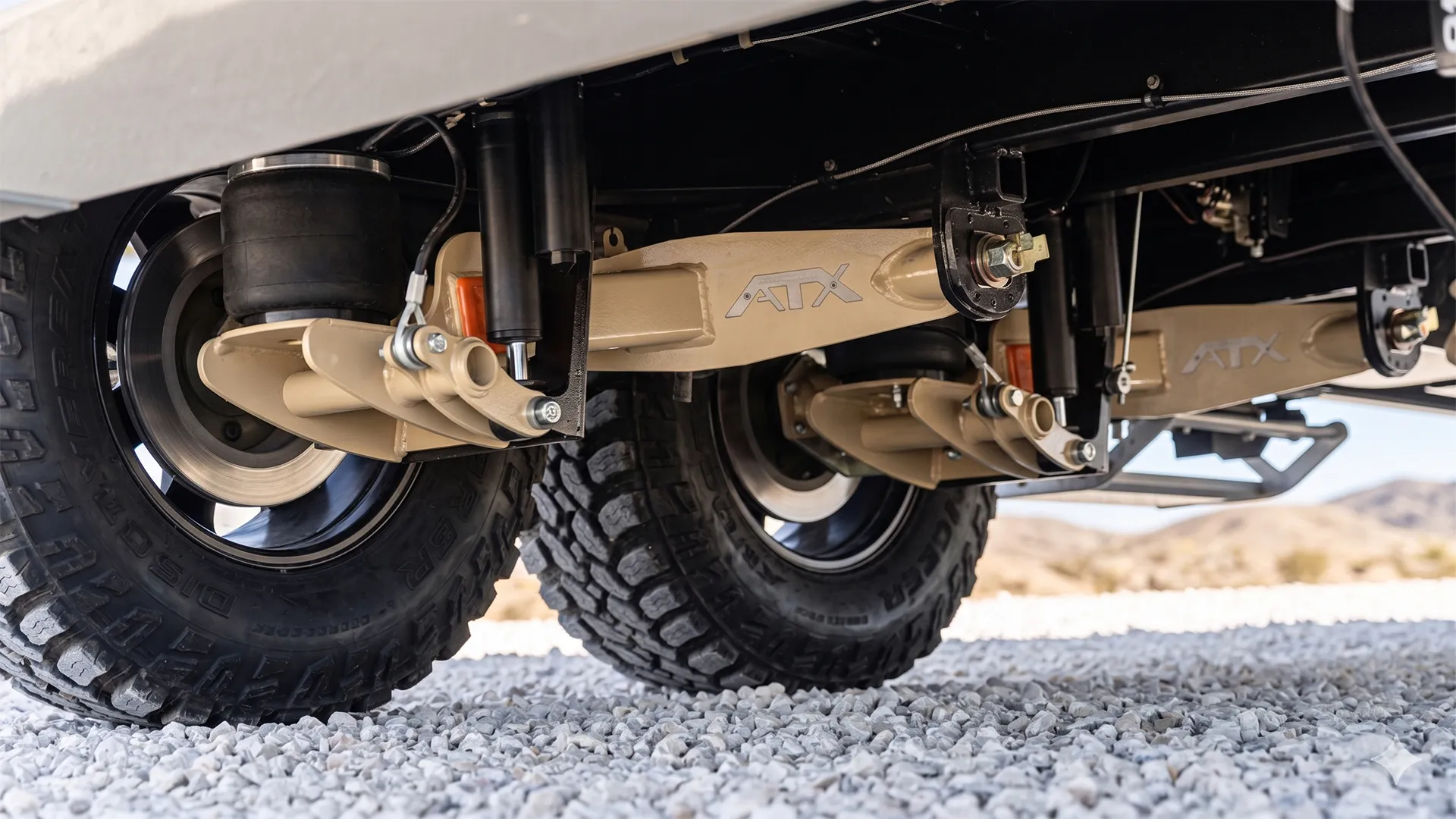
The Cruisemaster XT suits the lightweight Hybrid platform. Passive coil, single axle, 2.8T rated, designed for the corrugated tracks the Hybrid was built for. Not as heavy-duty as the bigger Scorpion systems, but appropriate to the body weight and tow vehicle range.
The ATX Coil 4.5T on the Scorpion Sting is the workhorse of the premium range. Passive coil, tandem axle, 4.5T rated. Built for the same routes as the Sting Air but without the active levelling. Buyers who prefer fewer electronic components and simpler service intervals choose this over the Air.
The ATX Airbag has a levelling system on the Gator X, Gator X EV, Sting Air, and Sting Air EV. Reads the ground and adjusts the airbags so the caravan is level. The difference between this and passive suspension is felt most on sustained corrugations, where the experience from tolerable to comfortable.
Power systems across the full off-road range
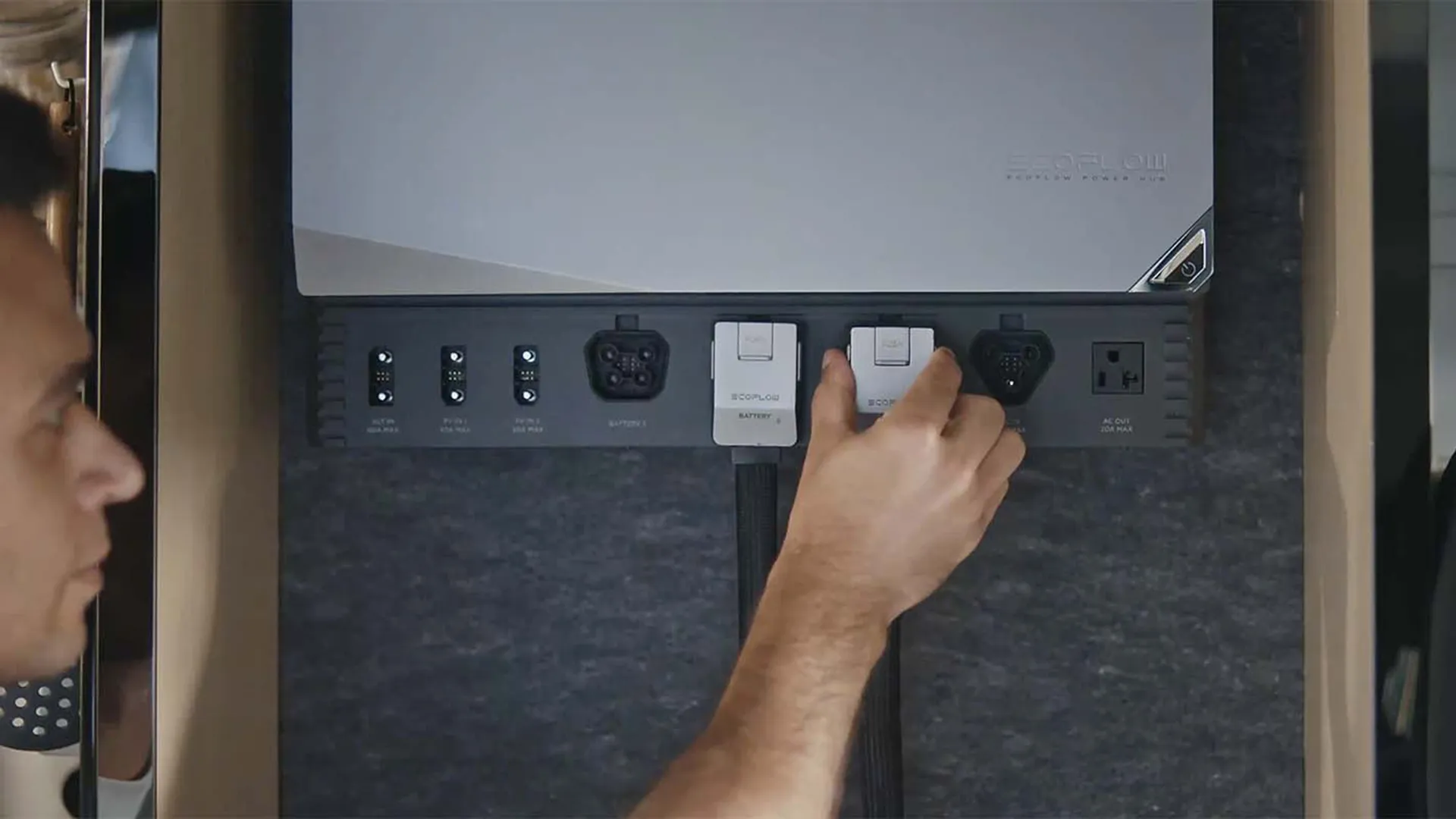
JB full off-road caravans run two EcoFlow lithium systems. The Gator Hybrid runs a 2kWh battery with up to 600W solar. The Gator X and Scorpion Sting run a 5kW battery (416Ah) with 800W solar. The Gator X EV, Sting Air, and Sting Air EV run a 10kW battery (833Ah) with 1,000W solar.
The numbers translate to nights off-grid.
The 2kWh Hybrid system handles two to three nights off-grid with sensible management. The 5kW system handles three to four nights. The 10kW system handles five to seven nights, including running the air conditioner intermittently. Each step up roughly doubles the off-grid capability.
The complete sizing guide, with worked examples for different trip patterns, sits in our caravan battery and power guide.
What tow vehicle do I need for a full off-road caravan?
The Gator Hybrid tows behind any mid-size 4WD with 3,000kg+ tow capacity. The Gator X and Gator X EV suit HiLux, Ranger, D-MAX, Fortuner, and similar at the top of their range. The Scorpion Sting needs a heavy-duty 4WD. The Sting Air at 4,500kg ATM needs a Silverado, Patrol, or Ram.
GVM is the number that limits you, not tow rating. Most 4WDs hit their GVM ceiling, the combined weight of vehicle, passengers, fuel, accessories, and ball weight, before they hit their tow rating ceiling.
A loaded HiLux can carry 600kg before the van is on the ball. Add a 350kg ball weight from a Sting Air, and the legal headroom is already gone. The Sting Air needs more vehicle than a mid-size dual-cab.
For the full breakdown of GVM versus tow rating with worked examples for each JB model, our tow vehicle and GVM guide covers the maths.
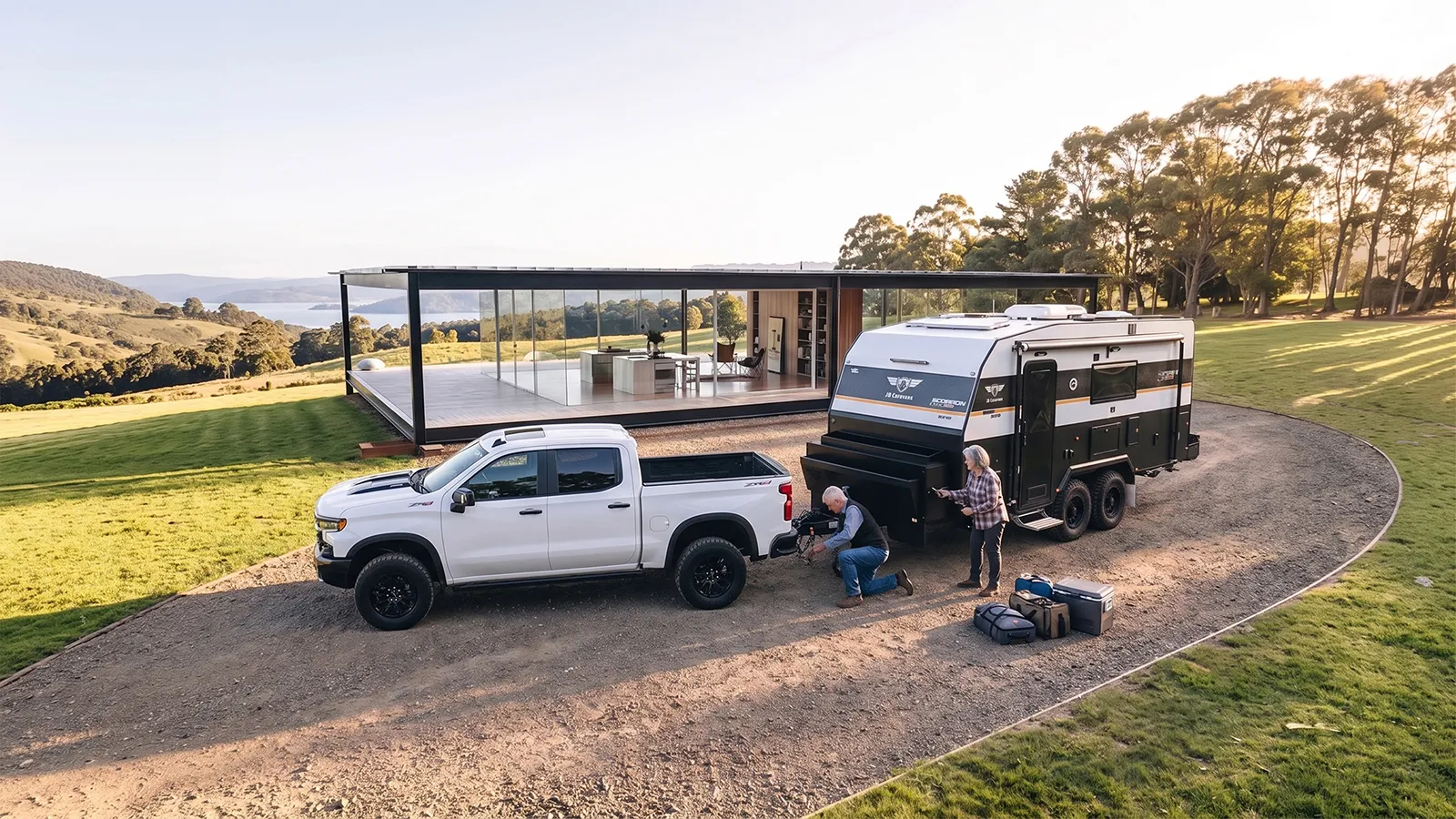
Are JB full off-road caravans Australian made?
Yes. Every JB full off-road caravan is built at the Campbellfield, Victoria factory. The same team welds the chassis, fits the interiors, tests the systems, and supports owners across the national dealer network from Perth to Townsville. Australian engineered, Australian built, Australian supported.
Full off-road country is hard on every component. The chassis takes more punishment. The seals take more dust. The suspension takes more cycles. When something needs attention in year three or year five, parts availability and dealer access become the difference between a one-week delay and a two-month delay.
Every JB full off-road caravan ships with a 5-year structural warranty. Every part on the van is sourced from a supplier with Australian distribution. Our piece on why Australian-made caravans matter covers resale value, ADR compliance, and the parts question in detail.
Ready to see the full off-road range up close?
The full off-road lineup with every model, layout, and current pricing sits on one page. Your local JB dealer can walk through the range and the choice with you.
Browse the full off-road range Find your nearest dealer